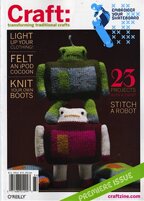
Craft
Questions with Publisher Dan Woods
1. The single most important achievement that Craft has achieved in today's marketplace?
Have you checked out the crafting category on newsstands lately? There's no shortage of craft-related magazines out there. However, we think there's a an opportunity for an entirely different editorial focus - one that encompasses a broad cross section of craft disciplines as opposed to focusing on a particular art form (i.e. knitting, crochet, weaving, scrap booking, etc.). Plus, we're still a relative newcomer to the magazine space (we launched Make: Magazine 2-1/2 years ago), so even with a unique and compelling product, commanding attention in a crowded category is enormously challenging.
2. What was the most important hurdle we overcame?
Our book publishing experience led us to adopt a circulation-driven business model that has about 90% of our revenue coming from circulation. With a 160-page book-like ("mook") format and an ad-to-editorial ration of less than 0.10, a newsstand cover price of $15 and an annual subscription of $35, we are anything but conventional. So how is this a challenge?
(a) Overcoming cover price sticker shock and getting people t o think different about what they're buying. If you compare it to a book, which is a far more realistic comparison, you instantly recognize the value. Still, when you ask a marketplace - newsstand buyers as well as readers - to think unconventionally, it's a challenge.
(b) with economics like ours, sharp discounting and broad-based comp distribution tactics (i.e. putting 1,000 free copies in conference reg bags) will kill the bottom line. We need to think and act craftier about getting our story out in the market.
3. What was the biggest pleasant surprise?
We were following our hearts and didn't really set out to target a specific age group. In fact, we really loathe age-based segmentation. Still, we expected that Craft would appeal most to young crafters who were tech savvy and perhaps a little more renegade in their approach to craft and art. However, we've been pleasantly surprised to see how much Craft: also appeals to more experienced crafters who seem to be seeking the same excitement they felt when they first discovered their craft years ago.
4. What is the biggest challenge we are facing today?
Really two-fold:
(a) Reaching a wider audience through broader newsstand draw while keeping our newsstand sell-through up. When you look at Craft as a book, it makes you cringe a bit to think of it being stripped.
(b) Finding niche crafters an d turning them onto a broader view of crafts and crafting, and doing this affordably.
5. If we had a magic wand and could strike Craft: and make it human?
A hip, non-judgmental (dare we say naughty) aunt who loves break the rules and part with convention all the while turning you on to new techniques and art forms while teaching you the fundamentals of a variety of craft disciplines.
6. What advice to offer someone starting a new magazine?
Find communities who matter and be real with them – for us, this means hackers, renegade designers, students, well meaning but hopelessly frustrated K12 teachers, artists, musicians, you name it. The folks on our team live and play in these communities; they know the people, the issues, what matters, and what doesn’t. Some of these communities need a little money; some want us to show up at their event; some want an online platform to share their ideas and designs; and some are potential contributors to our magazine. We probably spend half of our marketing money supporting these communities - funding small causes, issues, street level events, and people our staff believe in. What’s in it for us? Simple: Mobs of interconnected people who feel so passionate about our mission that they effectively become evangelists.
Open up your content to sharing – we’ve embraced digital distribution since we first launched. Not because it saves us money, but because it allows us to tap our most valuabl e asset – passionate readers. We allow a reader who has just come across a cool project to share it with a friend for two weeks for free. In fact, they can share the entire issue. It makes me shudder to imagine a passionate subscriber who comes across an awesome new project and they can’t share it with a friend. Right now!
Open your content to web searchers – search has become so completely ubiquitous with people googling for anyone and everything, if you’re going to be relevant to your audience you need to get your content in front of people when they’re looking for answers. We were one of the very first magazines to open up our full magazine archive to web searchers, providing seamless access for subscribers and free 6-page samples to non-subscribers.
Provide in-person opportunities for readers to interact with the brand – we discovered through some of our early street level events that something magic happened when we allowed readers and the community to interact with the staff, the magazine content and each other. So we launched Maker Faire – a weekend DIY festival attracting northward of 45,000 attendees and hundreds of maker participants who gather to celebrate the spirit of MAKE. We’re all used to hearing how people only recall so much of what they hear and so much of what they read, but that they retain almost everything that they physically do. Well that pretty much sums up the role of Maker Faire in our marketing mix.
7. In 2011 our magazine will be...
Like the "Joy Of Cooking" of crafting magazines, crafters will collect dog-eared back-issues of Craft in their 4-volume annual boxed sets and refer to the projects looking for ageless inspiration for years to come. And our most special wish would be that they pass along their archives to their children (and grandchildren).
|